Have you ever lost a friend and wondered for years what happened for them to suddenly remove you from their lives? Have you ever replied the last conversations in your mind, trying to find traces of something that might have been wrong, looking for signals that you might have missed or completely refused to see? Have you ever wondered what was that you did for them to feel like they no longer need you in their lives? Have you ever felt that perhaps you have taken too much space, clang too much to their presence, so that one day they just decided you were too much to handle?
How many years have you been haunted by what ifs? How many times have you wondered that maybe you were not a good enough friend for them, not valuable enough, not entertaining enough? Have you ever hurt more from a friend ghosting you than from a significant other breaking up with you?
Because I did. I did and felt all of the above.
And it left me emptier with every former friend that decided that I am not worthy enough to deserve at least an explanation. An “I don’t like you anymore”. An “I feel the need to stop talking to you, to take some space and move on with my life.”
I felt like I deserved a closure and it made me angry to realize I was not important enough to them, or respected enough, to deserve that closure. But as it happened to me more than once, I started to believe it more and more that “I’m the problem, it’s me”.
And the more it happened, the more I poured my soul into my remaining friendships, just to make sure I am there for them, to put them on the first place always, to be present, interested, loving, to be sharing my experiences. With each connection that I deemed valuable, I tried so hard, so desperately, and I put infinitely more effort than I did in love relationships.
As cold I might have been with some of my past love-interests, I could just not do it to the important people I used to call friends. So I kept finding excuses for them, not reading the signs, until they stopped giving a sign. Removing me off completely from their lives, just as you do with an insect that bugs you. And where did that leave me? To a place where I bled, and cried, and felt a grief so big, so harrowing, that I only experienced losing my brother.
***
So when I first saw the trailer for Banshees of Inisherin, I felt seen. I thought: “Someone understands that not only love-interests can cause you heartbreak, but also friends who no longer want you in their lives”.
Seeing the movie, I cried.
I looked at Pádraic (Colin Farrell) and thought: “I know that desperation.” That obsessive need to please them. The desire to know what you did wrong. To beg for a bit of love. The need to be seen and have that love reciprocated. To fix it all, forgive and forget and keep loving them as much as you can, even more.
What the movie does exceptionally well is to deliver an explanation. And even though the explanation is pretty weak, in my opinion, how many times have I not dreamt about the moment I would be able to confront this person, or another, and oblige them to make a confession. To tell me how I have hurt them or what was it that I did to justify their decision. Even in all that pain, I never stopped believing that the fault must be all mine. I just wanted the reason, so I could avoid doing that thing in other friendships.
But, as I watched the movie, a thought started to form. And so, days later, in the light of a person making her absence more visible each day, I realized that even with an explanation, I don’t believe I would’ve been able to find my peace, my closure, but rather do exactly what Pádraic does in Banshees…: try even harder to earn their friendship again, never even questioning if they were worthed to all the emotional availability or if they even wanted it, to begin with.
Pádraic Súilleabháin : Now… if I’ve done somethin’ to ya, just tell me what I’ve done to ya. And if I’ve said somethin’ to ya or maybe if I’ve said somethin’ when I was drunk and forgotten it. But I don’t think I’ve said somethin’ when I was drunk and I’ve forgotten it. But if I did, then tell me what it was. And I’ll say sorry for that too Colm. With all me heart, I’ll say sorry. Just stop running away from me like some fool of a moody school child.
Colm Doherty : But you didn’t say anything to me. And you didn’t do anything to me.
Pádraic Súilleabháin : Well that’s what I was thinking, like.
Colm Doherty : I just don’t like ya no more.
Pádraic Súilleabháin : [hurt and disbelieving] You do like me.
Colm Doherty : I don’t.
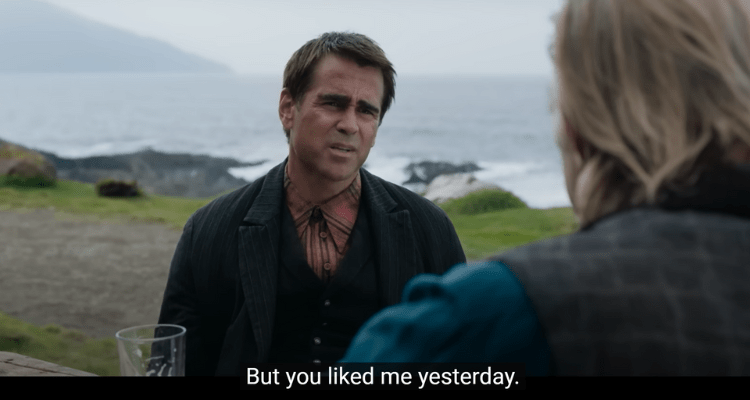
Pádraic Súilleabháin : But you liked me yesterday.
Colm Doherty : Oh, did I, yeah?
Pádraic Súilleabháin : I thought you did…
I had countless of discussions in therapy about this topic. Even my therapist told me recently that we must look for the reason I keep repeating this pattern. Why do I choose to give all of myself to people who end up not just leaving, but do it without a single explanation. I cried in therapy about it. I refused for many sessions to accept that friendships, just as relationships of any sort, can simply end, with no reasonable/rational explanation. They just do.
People fall out of love.
My therapist told me time and again that it is completely normal and natural for people dynamics to change, for people to leave and other people to take their places. But I just could not hear of it. Because I would never do it. I left behind of friendships before, but each time I forced myself to tell them: “This is what hurt me, I cannot go past that. This is where I drew the line and I cannot carry on being friends with you.” And after that, I was unwavering in my decision. But each time, I just waited and waited until I could take it no more, and even when I did end those friendships, I still missed the people I had to leave behind. I still carried a bit of love for them in my heart, no matter how much they hurt me.
And this is where it took time for me to understand what the therapist was trying to make me understand: in all those failed friendship, where I was the ghostee, I kept projecting my expectation and my set of values on the way they reacted. I wanted for them to act how I would have acted. To have my set of values. So it did not only hurt, because I felt abandoned, but I felt that my expectations have been deceived.
***
I spoke earlier about grief. Unfortunately, I have felt true, raw grief. I met Grief, looked her in the eyes, and let her take control of me. The one where you know there is no turning back from it. Where loss is not reversible, but definitive and haunting, and damaging. And even though it might seem hard to believe, being ghosted by someone you completely trusted, and cherished and considered a close friend, is a form of grief in itself.
Colin Farrell does such a wonderful job in portraying how grief can feel once you lose your closest friend, not because of death, but because of choice.
Throughout the movie, his character goes through all the stages of grief. At first, he is in denial, tries to pretend that everything’s the same. He bargains, gets depressed. Tries and tries and tries, even though all the other people in his life tell him to just let Colm (Brendan Gleeson) be. The more rejected he gets, the more he tries to fix everything. Until he realized that all that love, all those efforts, are met with cold indifference. That is when he seems to realize that the person he’s been friends with for so long does not even exist in real life. He’d been friends with the expectations of how a friendship should look like. He projected on Colm all the ways in which he expressed his gratitude for the connection they shared. And that is where anger began to take control of him.
I love this dialogue in which drunk Pádraic finally lets go of his expectations. He stops trying to win his friend’s acceptance.
Pádraic Súilleabháin : Do you know what you used to be?
Colm Doherty : No, what did I used to be?
Pádraic Súilleabháin : Nice! You used to be nice! And now, do you know what you are? Not nice.
Colm Doherty : Ah, well, I suppose niceness doesn’t last then, does it, Padraic? But will I tell ya something that does last?
Pádraic Súilleabháin : What? And don’t say somethin’ stupid like music.
Colm Doherty : Music lasts.
Pádraic Súilleabháin : Knew it!
Colm Doherty : And paintings last. And poetry lasts.
Pádraic Súilleabháin : So does niceness.
Colm Doherty : Do you know who we remember for how nice they was in the 17th century?
Pádraic Súilleabháin : Who?
Colm Doherty : Absolutely no one. Yet we all remember the music of the time. Everyone, to a man, knows Mozart’s name.
Pádraic Súilleabháin : Well, I don’t, so there goes that theory. And anyway, we’re talkin’ about niceness. Not what’s his name. My mammy, she was nice. I remember her. And my daddy, he was nice. I remember him. And my sister, she’s nice. I’ll remember her. Forever I’ll remember her.
Colm Doherty : And who else will?
Pádraic Súilleabháin : Who else will what?
Colm Doherty : Remember Siobhan and your niceness? No one will. In 50 years’ time, no one will remember any of us. Yet the music of a man who lived two centuries ago…
And anger pushes him to do crazy things, too.
He gets the anger out of his system so he could finally be able to let go. He doesn’t want to let go, but he feels that he has no other choice. He had tried and tried and tried, until he also fell out of love with his friend. And that is when acceptance comes, and the grief stages are completed.
Pádraic Súilleabháin: Some things there’s no moving on from. And I think that’s a good thing.
***
I loved having the perspective of the other character. There was someone from my past who once gave me a heads up that she might be disappearing at some time in the future. No other explanation just that she will do it. We were very much into Elena Ferrante’s Brilliant Friend series and she identified with Lyla. I knew she was going through some very hard times and emotions, and I tried to be there for her.
But as she actually cut me off, I started to ask myself that maybe I was part of her struggles. Maybe I put too much pressure on her, suffocating her. It haunted me and it was so damn hard to get past this. I never, once, asked myself if she ever did the same for me. I was hurt that this had happened the same year my brother died, so being ghosted felt like experiencing a second death, since she blocked me on social media, Whatsapp, phone, everywhere. To me, it was like she completely disappeared from the world. And with her struggles, I kept wondering each day if she was still alive and what could I do to help her.
But I also needed a shoulder to cry on. I also needed a support system.
And couldn’t understand why I felt so abandoned until countless therapy sessions later. It was a need to be seen. To be loved and accepted and to have all that loyalty recognized. It was a need of acceptance and affection and attention that my inner child needed. And that people have their own struggles and that it’s normal for them to take care of them first and then think of others. But see, because I always put others on the first place – even when I bled on the inside – I expected for each and every one of my friends to do the same. Because that was what I needed.
So on a subconscious level, all those efforts were done because, just as Pádraic in Banshees in Inisherin, was something I hoped to receive in return.
***
It is a very long text. But I don’t know how to write shorter ones, so I’ll keep writing for a little bit more.
By working on myself, by trying to break my pattern, I realized why I kept doing that. So at a certain point, I saw myself doing the exactly same thing recently, with someone else who never asked me a basic “How are you?”. But I just kept finding excuses for them. Even when I was heartbroken. Even when I got depressed because my relationship was failing. Even when I was happy I discovered something about myself and they never asked anything about it.
The person never asked questions. I was the one to always initiate conversations and I told them more than once how important they were to me. I kept reassuring them I was there if they wanted to talk about their struggles.
But I wasn’t the first option. I think I wasn’t even the 10th. I might have been just a casual friend. But projecting my attempts and my feelings and expectations, I thought we were on the same page. Until I stopped texting. And the texts never came back. No “Are you okay?”, no “Is anything wrong with us?” Cold stone silence.
Once again, I felt abandoned. I felt hurt. I felt betrayed. But then I asked myself: ”Would that person have answered if I called at 4am?” Nope. Because I was always left on read when they felt like it. Even though I always responded instantly. I was extremely available because I needed them to be the same. It was my need to be put on the ‘close friends’ list. It was my need to be asked how I was. And crazy enough, I think I never fully understood that, I think I never fully reached the 5th level of grief, until I heard a Mel Robbins podcast on friendship (Start Here, ep 2, on Audible), in which she talks about different types of friends: leaves, branches and roots. And while I considered that person a root, perhaps I was just a branch to her – or even a leaf. I projected my expectations on the friendship and never truly acknowledge the real nature of it.
Colm Doherty : I was too harsh yesterday.
Pádraic Súilleabháin : Yesterday, he says! I know well you was too harsh yesterday.
Colm Doherty : I just… I just have this tremendous sense of time slipping away on me, Padraic. And I think I need to spend the time I have left thinking and composing. Just trying not to listen to any more of the dull things you have to say for yourself. But I am sorry about it. I am, like.
Pádraic Súilleabháin : Are you dying?
Colm Doherty : No, I’m not dying.
Pádraic Súilleabháin : But then you have loads of time.
Colm Doherty : For chatting?
Pádraic Súilleabháin : Aye.
Colm Doherty : For aimless chatting?
Pádraic Súilleabháin : Not for aimless chatting. For good, normal chatting.
Colm Doherty : So we’ll keep aimlessly chatting and my life will keep on dwindling. And in 12 years, I’ll die with nothin’ to show for it, bar the chats I’ve had with a limited man, is that it?
Pádraic Súilleabháin : I said, “not aimless chatting” I said “Good, normal chatting.”
Colm Doherty : The other night, two hours, you spent talking to me about the things you found in your little donkey’s shite that day. Two hours, Padraic. I timed it.
Pádraic Súilleabháin : Well it wasn’t me little donkey’s shite, was it? It was me pony’s shite. Which shows how much you were listenin’.
Colm Doherty : None of it helps me. Do you understand? None of it helps me.
Pádraic Súilleabháin : [after Colm leaves] We’ll just talk about something else, then!
So it wasn’t the person’s fault for not sharing personal things with me, for not being available, for not texting me to hang out, for not wanting to know how I am.
Because for her, I was a branch, or perhaps a leaf – we had some common background, some common hobbies, and perhaps she just didn’t know how to tell me that I am not one of the people from her support system, but just a person she shares some passions with. And while I poured all my soul into that friendship, she didn’t need all my soul to begin with. She just needed the common ground.
I don’t know if that’s real. That is just how I got to read that situation, in order to be able to let go of the friendship and move on with my life.
My therapist also asked me if the person was acting different or if that was always our dynamics. And I was forced to admit that, even though at times they seemed to pay more attention, they were never completely engaged, and that was the case even from the beginning. So I just read the situation wrong, and caused myself a lot of trouble, investing way more than the person actually wanted me to. Or needed me to.
That’s the story with Pádraic and Colm, too.
One was too invested and he is too absorbed by his needs and his expectations of how a friend should react, so he is not able to actually listen to what the other person needed all along.
So, in a way, I got to recognize that maybe I did something wrong in the end. By trying too much, I overshared, I overexisted in the life of a person who probably liked me, but not as much as I liked them. Who needed my presence less than I needed theirs. It was just a matter of not setting the boundaries straight. Of not recognizing and communicating the needs clearly.
Or who knows, perhaps all of the people who friend-ghosted me stated their needs, just like Colm, but maybe I was too caught up in my triggers of being abandoned, just like Pádraic, that I refused to hear them, thinking I probably knew better than them what our friendship actually needed.
***
To conclude this very long personal essay on Banshees of Inisherin, to me it was exceptional, and it deserves all the praises.
The actors are flawless.
Their dynamic is so humane, so imperfect, that it haunts you for days and days, making you re-visit all the friends that cut you off on the way.
Watch trailer here:
 Alta's World